Oct 19, 2026Buying Guides
PVC vs Soft Transparent EVA Cosmetic Pouches | Real Sourcing Review
We compare clear PVC cosmetic pouches and soft transparent EVA pouches side by side—clarity, hand feel, creases, cold resistance, compliance and cost—from a real bag factory perspective.
PVC vs Soft Transparent EVA Cosmetic Pouches | Real Sourcing Review
We compare clear PVC cosmetic pouches and soft transparent EVA pouches side by side—clarity, hand feel, creases, cold resistance, compliance and cost—from a real bag factory perspective.
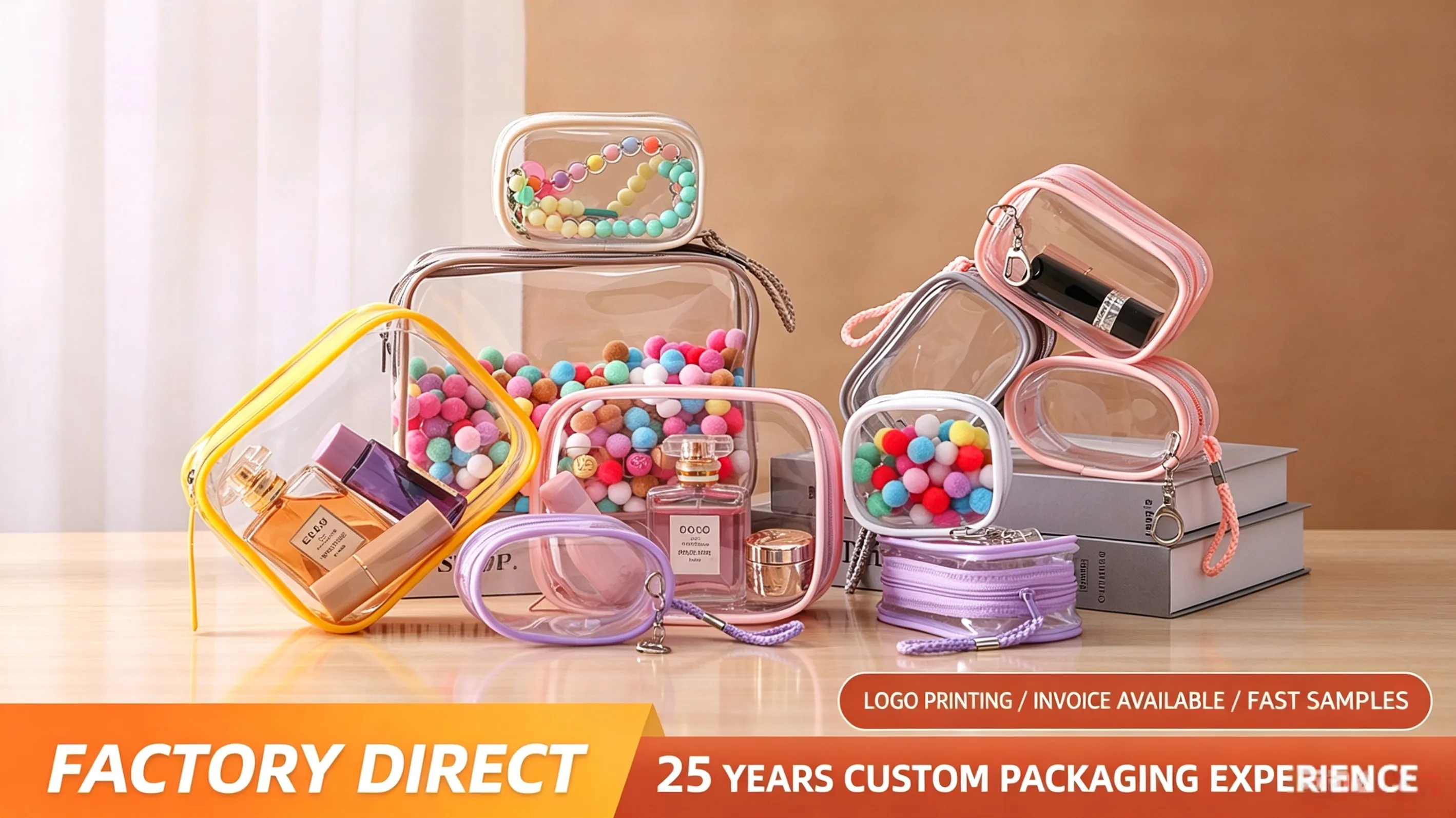
If you’re developing clear cosmetic pouches, toiletry bags or travel storage bags right now, there’s one question you’ll probably run into sooner or later: should I use PVC or soft transparent EVA?
It sounds like a simple material choice, but I’ve seen many buyers get stuck here.
A lot of people first think of EVA as rigid hard cases—earbud cases, eyeglass boxes, molded protective boxes. So they assume EVA must be stiff and not suitable for soft, transparent cosmetic pouches. But EVA is not just one material. Cast EVA film can be soft and fully transparent. That’s why many buyers end up comparing “clear PVC bags” with “hard EVA cases,” when the real choice they should be making is between clear PVC and soft transparent EVA pouches.
At Lvfeng Packaging, I often place PVC and soft EVA samples side by side on the table and let clients touch, fold and load them with real items. These material differences are hard to judge from product photos alone. Before placing a bulk order, it’s worth feeling the actual samples.
1. Don’t ask which is better first—ask whether you need “display” or “gentleness”
The first visual difference between clear PVC and soft transparent EVA is clarity.
For the same transparent cosmetic pouch, PVC usually delivers higher clarity. The high-transparency PVC pouches we make often show the color and outline of lipsticks, compacts and skincare bottles clearly. If you’re making travel toiletry bags, airport security bags, retail display pouches or products where the main photo needs to show contents directly, PVC is usually a strong choice.
Soft transparent EVA can also be fully clear, but its transparency is not the sharp, glass-like clarity of PVC. It often looks softer and slightly warmer. This is not necessarily a disadvantage. Some clients prefer soft EVA for gentle, minimalist or mother-and-baby style brands because it feels less “cheap plastic” than some PVC versions.
So at this stage, don’t rush to pick one material. Ask yourself: do I want the product to be highly visible on the shelf, or do I want it to look warmer and more premium? That question alone will guide your choice.
2. Hand feel is something you only understand after holding the sample
Many buyers think PVC and soft EVA look similar from product photos, but the moment samples arrive, the difference becomes obvious.
PVC usually feels stiffer, with a slightly cool surface. The pouch body has some structure and doesn’t collapse completely when placed on a table. Thickened PVC is flexible and bounces back relatively quickly after folding, which makes it a mature choice for cosmetic pouches, toiletry bags and zipper storage bags. The downside is that some PVC materials, especially lower-grade ones, may develop faint white creases after being folded in the same position for a long time or compressed in luggage.
Soft transparent EVA feels warmer and more delicate. Many female clients say it simply feels more comfortable in hand. It is also more crease-resistant than many PVC materials. After being folded repeatedly or squeezed into luggage, it is less likely to develop obvious white marks. That matters a lot for travel storage products, because consumers don’t treat them gently.
None of this means soft EVA is always more premium. It depends on your brand positioning. My best advice is: ask for both samples, fold them, and let different people on your team touch them. Material decisions are cheaper to correct at the sampling stage.
3. Both are reasonably waterproof, but sunlight and cold weather are the real test
If you’re making ordinary transparent storage pouches, both PVC and soft EVA have decent water resistance. Splashes from a bathroom sink, wet towels in travel, or light rain won’t usually cause major issues.
But if your product will be exposed to sunlight for a long time—near windows, on outdoor display racks, or in strong retail lighting—then aging matters. Standard PVC may gradually turn yellow under long-term UV exposure. Soft EVA often performs better in color stability.
Cold climate is another dividing line. If your market is Northern Europe, Canada, Russia or other regions with cold winters, PVC may become stiff and brittle in low temperatures. Soft EVA usually stays more flexible in cold conditions.
This doesn’t mean all PVC is bad or all soft EVA is perfect. It means you need to think about where the product will actually be used. The more specific you are about your market, the better the factory can match the right material.
4. Compliance often matters more than you think
Many buyers choose a material based on cost or appearance, only to get stuck later on compliance.
PVC usually needs plasticizers to stay flexible. If the raw material is low grade, phthalate levels may fail EU or US testing. I’ve seen buyers choose a cheaper PVC supplier, only to have the goods detained at the port. By the time that happens, shipping costs, storage fees and rework costs are far higher than the money they saved at the beginning.
Soft transparent EVA is often seen as more stable in compliance, especially for maternity, children or beauty-related products, because it does not rely on the same plasticizer system as PVC.
But I want to be objective here: EVA is not automatically “100% safe,” and PVC is not automatically unacceptable. What matters more is the grade of raw material the factory uses, whether it can provide test reports, and whether the specification is locked in before production.
So don’t only ask “how much.” Also ask: what compliance testing does this material support, and can it meet my target market requirements? Many problems can be avoided just by asking that one question early.
5. Why is EVA usually more expensive than PVC?
If you’re making basic clear zipper pouches, promotional gift bags or low-budget retail items, PVC is usually the more cost-effective choice. It has a mature supply chain, lots of material options and works well for volume production.
Soft transparent EVA is generally more expensive. The cost difference comes not only from the raw film, but also from production difficulty and process control. So it is more often used by mid-range brands, maternity lines, travel sets and markets with stricter environmental requirements.
I don’t recommend locking the material first and then looking for a market. It works better the other way around. Tell the factory your positioning and target market first, then let them suggest materials.
6. Practical advice for buyers
After reading a comparison like this, you may start thinking “PVC fits this, EVA fits that.” But in real sourcing, I suggest you decide in this order:
First, look at the end-use scenario. For airport toiletry bags, basic cosmetic storage or promotional gifts, PVC is often enough. For maternity products, mid-range travel sets and markets with stricter environmental requirements, soft EVA may be worth considering.
Second, always ask for physical samples. They may both look “clear” online, but the hand feel, crease recovery, clarity and overall quality with zippers can be very different. Check four things: clarity, hand feel, crease recovery and odor.
Third, talk about compliance early. Don’t think about testing after bulk production starts. Locking the material standard, test items and target market before production reduces the most risk.
Fourth, start with a small trial order. Especially when working with a new material, don’t place a huge order immediately. Test the market first, collect real feedback, then decide whether to continue with the same material or adjust.
7. Closing thoughts
There is no absolute winner between PVC and soft transparent EVA. PVC usually wins in display effect, cost and supply chain maturity. Soft EVA often wins in hand feel, crease resistance, anti-yellowing behavior and compliance confidence in certain markets.
But I want to be clear: all material decisions should be based on actual samples and your real requirements. Don’t rely only on a supplier’s casual statement or a generic online comparison table.
If you’re developing clear cosmetic pouches, toiletry bags or travel storage bags, do two things first: explain your target market, budget and brand positioning; and ask the factory to send you both PVC and soft EVA samples.
Once you have them, fold them, put some bottles inside, and leave them near a window for a few days. More often than not, the right material is found through real testing, not theory.